Could French Far-Right Local Election Gains Pave Way to the presidency?
In Hénin-Beaumont, a former mining town ringed by man-made mountains of coal refuse from a bygone age, the streets were nearly deserted on a recent morning in mid-March. Few braved the unrelenting rain to shop at the outdoor market, where sellers often outnumbered customers.
Rachid laid out his cleaning products, pushing water from the roof of his sagging tent, a few metres from campaign posters of Mayor Steeve Briois. “He’s the same as the other politicians, no better, no worse,” said Rachid, who only provided his first name. “We only see them here at election time.”
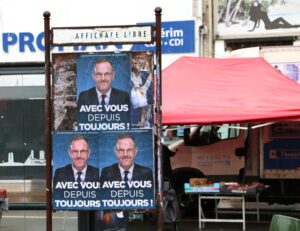
Signs promoting incumbent Mayor Steeve Briois, who was re-elected last weekend in the first round of municipal elections. (Kyle G. Brown/CBC)
Briois, a stalwart of the National Rally party (Rassemblement National, or RN) and a close ally of far-right leader Marine Le Pen, is running for a third term. In 2014, he unseated a left-wing coalition tainted by the conviction of a former Socialist party mayor for embezzlement.
“Hénin-Beaumont was bankrupt,” said Joe, a farmer selling vegetables from his orange tractor, who also only gave his first name. “Briois is always out meeting people, and he has put the town back on track.”
After being acquitted for incitement to racial hatred over a tweet linking immigration to an “explosion of sexual assault” across Europe, and cleared in 2024 of discrimination charges related to a pamphlet promoting “national preference” for French citizens over immigrants in access to social services, Briois has largely avoided scandal in recent years and focused on local governance.
“He attends local gatherings — village dances, scrabble contests — keeps the streets clean, puts out flowers,” said Nonna Mayer, professor emerita of comparative politics at Sciences Po in Paris, specializing in far-right movements. “He does the everyday job of a good mayor. He’s an excellent manager.”

Hénin-Beaumont’s city centre, dominated by an elegant town hall, is clean and well-maintained. But Houari Benhadja, a local candidate for the left-wing party France Unbowed (France Insoumise), says large parts of the town have been neglected.
Benhadja pointed to boarded-up buildings and one vacant property with a tree growing out of the second-floor window.

“You can go all around and see there are no flowers. There’s nothing,” Benhadja said, criticizing the privatization of the swimming pool and day care centre. “Children don’t eat flowers. I want them to eat good food at school, for free. Thirty per cent of children go to school hungry, and 25 per cent of residents live below the poverty line.”
Hénin-Beaumont sits in a National Rally stronghold in Pas-de-Calais, one of several northern towns once dependent on mining and steel.
“In the late ’70s and early ’80s, everything closed down,” said Jean-Yves Camus, a political analyst with the Jean Jaurès Foundation, a think-tank. “This is now the third generation living on welfare or on odd jobs with short contracts.”
The dismal status quo has had little impact on the mayoral race: Briois was re-elected last Sunday with 78 per cent of the vote, part of a strong showing for the far right across the country. More than 20 municipalities elected or re-elected National Rally mayors in the first round, and the party leads in more than 60 — compared to just 11 in 2020.
“It’s a vote of despair,” said Camus, “from people who feel abandoned by mainstream parties.”
Controversial candidates
These elections mark another step in RN’s decades-long journey from the political fringes to the mainstream. After rebranding the National Front the National Rally in 2018, Marine Le Pen has made steady gains at the national level.

With more than 120 seats in the National Assembly, the RN is now the largest party in the French parliament. Local politics, however, have long been a secondary priority.
“To win the presidency, [Le Pen] needs people at the grassroots level who prepare the ground for elections to parliament and to the presidency,” said Camus.
In recent polls, National Rally is expected to win next year’s presidential election, under either Le Pen or her 30-year-old protégé Jordan Bardella. (Le Pen awaits an appeal court ruling on a sentence barring her from public office after a court found her guilty of misappropriating public funds.)
Despite more professional campaigns, the party still struggles to shake its reputation for extremism. Candidates’ links to hard-right activism and offensive social media posts continue to trigger accusations of racism and demagoguery.
French media have documented dozens of controversies, from remarks about a “massive influx” of African “barbarians” to Nazi salutes and related paraphernalia online.

RN officials have withdrawn some candidates and party president Bardella has pledged tighter vetting, with plans to use open-source intelligence to dig into candidates’ past. So far, the effort has had limited effect, with new, embarrassing incidents surfacing regularly.
Steeve Briois told CBC News such online outbursts bear no relation to the party.
“There’s real life, and there’s social media,” he said. “We live in real life, and there’s been no evidence of xenophobia in Hénin-Beaumont — or anywhere else.”
Small-town appeal
With the exception of Marseille, where the National Rally is in a tight runoff against a left-wing coalition, the far right has less appeal in big cities, which tend to have larger immigrant populations and more affluent voters with a higher level of education.
But in smaller cities like Villers-Cotterêts, an hour north of Paris, opposition candidates have their work cut out for them. They’ve been out canvassing across this town of 10,000 to convince locals to vote out the RN, which has been in office since 2014.
“When we add up far-right votes here and in neighbouring villages, we reach 60 per cent,” said local resident Hélène Hervé, a retired psychotherapist. “That’s quite terrifying.”

Her husband, Gérard, says it’s impossible to disentangle the local party from broader, increasingly frequent anti-immigrant rhetoric.
“Rather than changing people’s circumstances, we blame others,” he said. “I tell people, ‘You could get rid of all the Arabs in France — your train still won’t arrive on time.’ The problem is economic, it’s infrastructure that hasn’t been upgraded.”
After two terms, Villers-Cotterêts Mayor Franck Briffaut is stepping down, making way for his deputy Gaëlle Lefèvre to run for the town’s top job.
“Look around you,” Lefèvre said, as she greeted locals downtown recently. “The streets have been redone, the centre refurbished. And we avoid imposing additional costs on residents.”
Beyond the centre, however, conditions are less polished.
“The mayor kept a low profile,” said Richard Toure, 79. “He hasn’t spent much, and it shows — potholes, poorly insulated schools, even a cinema without heating.”
But that’s not why the retired accountant can’t bring himself to vote RN.
“We could never vote for a racist party,” he said.

For Marie-Laure, 53, local considerations outweigh national politics.
“At this level, party labels won’t change the world. It’s the individual that counts,” she said.
A lingering contradiction
In 2023, President Emmanuel Macron visited Villers-Cotterêts to inaugurate the International Centre for the French Language, a restored castle complex meant to revive the town and counter far-right appeal.
Earlier that year, Yannick Champain of the Human Rights League arrived at the town’s fading media library to discover he could no longer use the space to give French classes to refugees and immigrants.
“We were surprised,” he said. “These classes help people settle and integrate.”

It was another blow to the organization following the mayor’s withdrawal of funding during his first mandate. Lefèvre defended the decision in a television debate last month, saying the Human Rights League was “political.”
Opponents of the RN in other cities have also complained of budget cuts to local associations, social services and cultural activities.
Villers-Cotterêts’s centrist candidates have united ahead of Sunday’s runoff, where Lefèvre faces a consolidated opposition.
Despite the dozens of RN mayors likely to be elected in France on Sunday, its strongholds, scattered in a few regions, remain limited.
“They are still not as well-anchored in the political landscape as they had hoped,” said Nonna Mayer, who noted the party’s efforts at professionalism have been patchy.
“They lack solid candidates with the competence and credibility to govern nationally.”
An RN candidate admitted as much to the daily newspaper Le Monde this week.
“The local election results in the major cities are the real test of [our] foothold in the country,” said Thierry Mariani, who came in sixth place in Paris’s race, with 1.6 per cent of the vote.
Mayer said that ultimately, they need to win more — and larger — cities to prove they’re capable of running the country.



