Protests banned, demonstrators beaten by police and another thousand arrests: this is the face of an increasingly authoritarian French government in the dying throes of Emmanuel Macron’s presidency.
Although half a million people across France marched on Saturday, protesters in cities like Lyon were beaten with truncheons and tear gassed for defying bans imposed days after Macron warned that only protests considered “legitimate” would be allowed. “The recommendation is that there should be no demonstrations in the coming days,” he warned on Thursday.
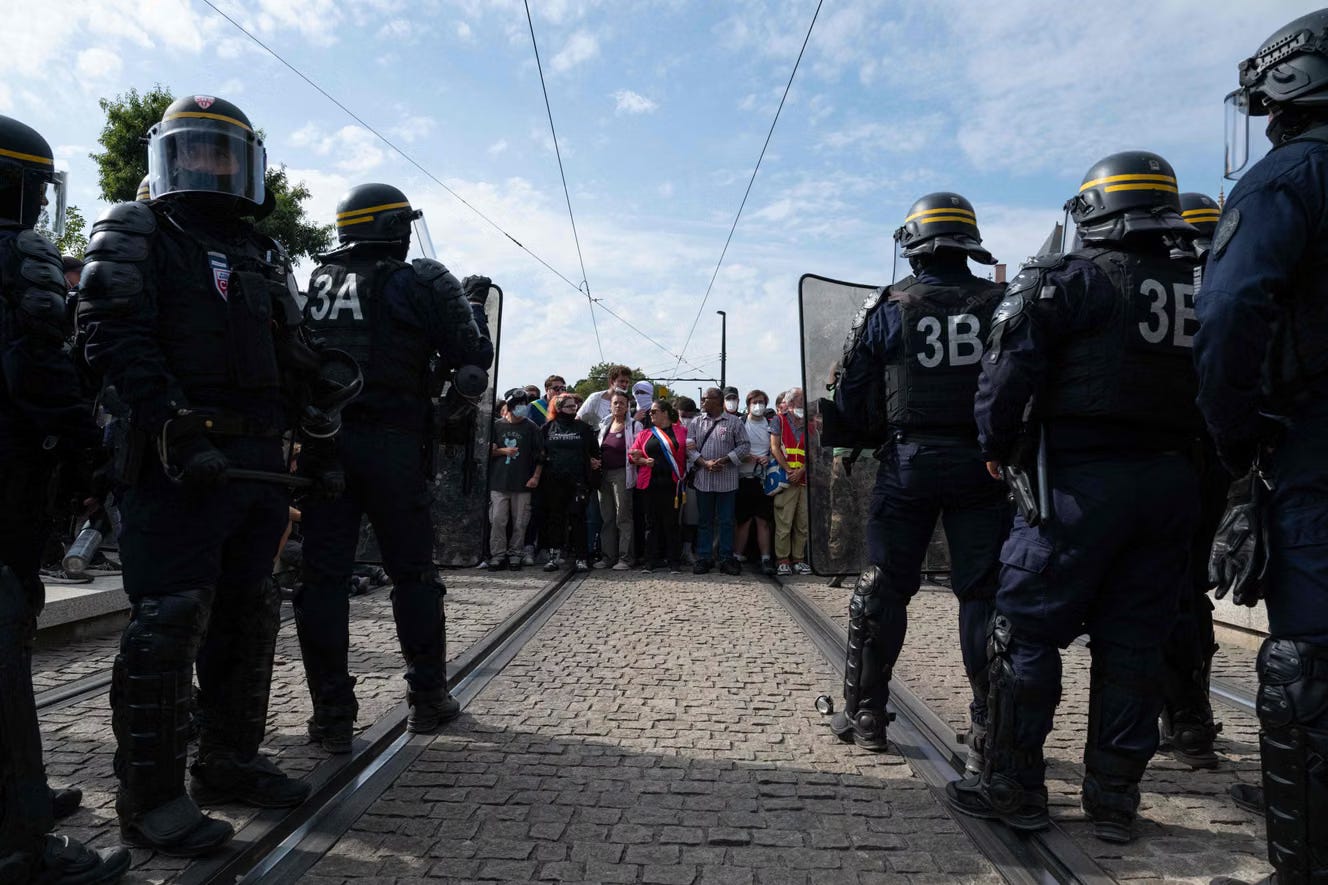
High school student demo in Nantes, Oct. 6. Sébastien Salom-Gomis / AFP
October 17
When the French Interior Minister suspended the use of stun grenades after young people were seriously injured earlier this month, including a teenager whose hand was blown off, one would have been forgiven for hoping Laurent Nunez was rethinking the doctrine of violent confrontation that passes for crowd control.
As it turned out, the suspension lasted only a few days: he reinstated the military-grade weapon in time for the march on Saturday, October 17 – a date likely to go down in French history as a symbol of state repression.
As thousands of people, including students, parents, healthcare workers and firefighters set off from Place de la République, I watched riot police engage in pitched battles with youths, many of whom fled at the first whiff of tear gas.
It was tragicomic overkill. Police formed ranks and charged, swinging their batons indiscriminately, injuring bystanders and sending crowds scattering. Both police and youths then regrouped and resumed the ritual – again and again. Had the police simply stood down, the youths might well have dispersed too.
Meanwhile, just a few hundred metres away, shops, bars and restaurants were being stripped bare.
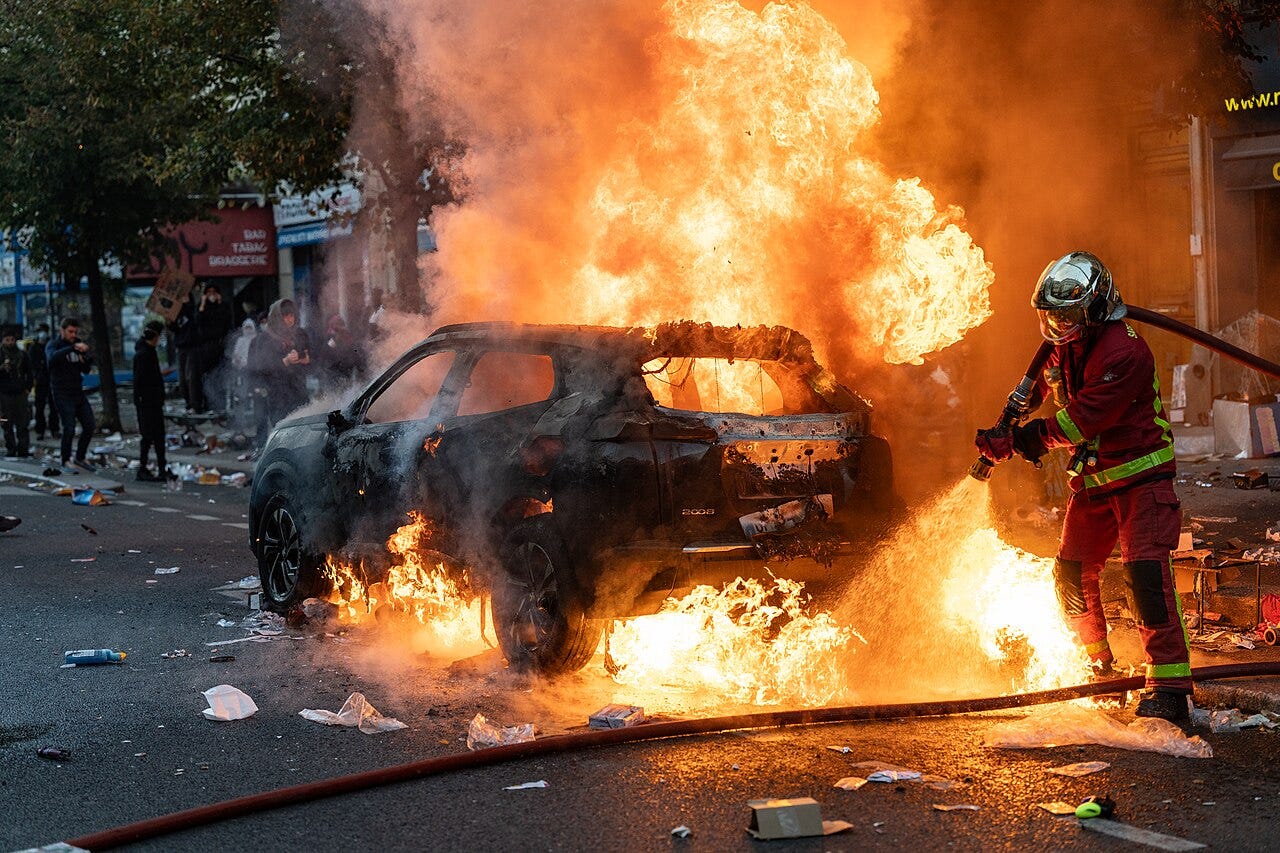
Paris, Oct. 17 © Jorge Jaramillo
In a country accustomed to protest and the fringe elements that exploit it, it was surprising to see such large swathes of the city unpoliced, as young men smashed shopfronts and calmly emptied stores of their contents.
I watched this too, just a couple of blocks from police officers who held their ground as though ceding an inch to the masked youths in black would amount to defeat.
Thousands of businesses – most of them small, run by a handful of people – were pillaged, causing millions of euros in damage. The government has since vowed it will not happen again.
So what’s their strategy?
Like the hammer that can never have enough nails, Nunez has concluded that what France needs is not smarter policing, but more cops. Lots more.
French police have long been criticised for escalating confrontations rather than using de-escalation techniques practised by their European neighbours. They have been repeatedly singled out by the United Nations, the European Court of Human Rights and the French courts for the use of excessive force and racial profiling.
Activists say the brutality is part of the plan. News of heavy-handed policing spreads far and wide, and many have stopped attending demonstrations out of fear for their own safety.
Nor is the crackdown limited to law enforcement. Justice Minister Gérald Darmanin issued a directive to prosecutors urging them to seek severe sentences against those responsible for “urban violence.”
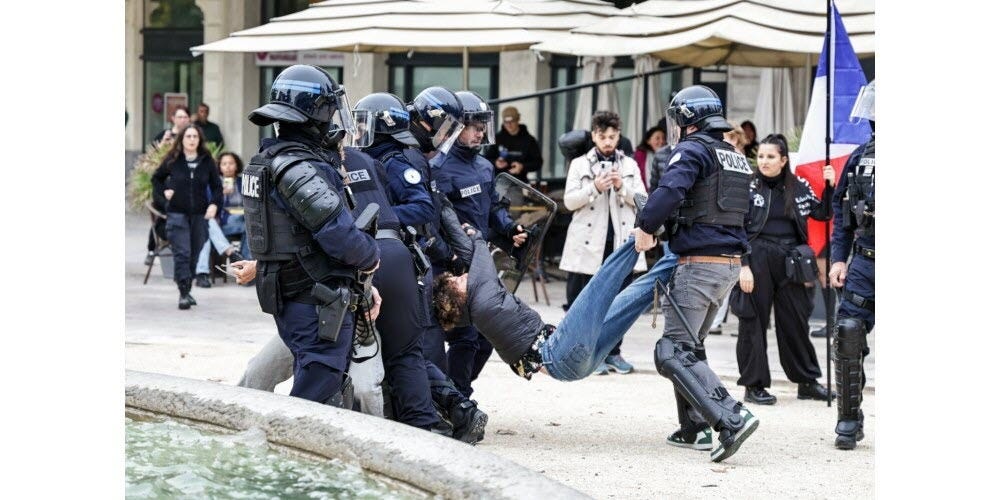
Valence, 24 Oct. Albert Lictevout
Hundreds of cases were fast-tracked in the first few days. Threatened with prison, defendants with no criminal record have been pressured to plead guilty in exchange for a lighter sentence.
Defence lawyers describe injuries allegedly caused by police beatings, and have circulated images of rubbish-strewn prison cells where youths sleep on the floor without blankets, beside urine-filled water bottles because of restricted access to toilets.
“From violent arrests to police custody and [expedited] court hearings, the aim is to terrorise an entire generation,” wrote some 200 lawyers in an open letter.
This is the grotesque reality behind the closing curtain on an increasingly authoritarian government, more concerned with silencing dissent than tackling the social problems at its source.
Justifying state repression
Four weeks after high school students blockaded schools over unsanitary conditions, dilapidated buildings and chronic teacher shortages, the government has yet to offer a single substantive solution. Its initial response was instead to dismiss the entire movement as a form of “urban crime.”
Even as the movement widens with parents, teachers, workers and labour unions mobilising against budget cuts and inflation, the government has responded with curfews in Paris and other cities, an increased police presence, and helicopters overhead.
Darmanin said law enforcement would step up the use of GPS tracking and facial recognition, and Prime Minister Sébastien Lecornu called for police to be reinforced by a military units.
“It is now time to choose sides,” he said earlier this week. “Either you’re on the side of the Republic, and therefore the police…or you are on the side of the rioters.”
The implication is clear: question the police and you stand with outlaws. A formulation reminiscent of George W. Bush’s “you are either with us, or you are with the terrorists” speech after 9/11.
This us-versus-them narrative tends also to demonise political opponents, and the government has duly accused Jean-Luc Mélenchon and La France Insoumise (LFI) of somehow orchestrating the entire student movement. Now, the rhetoric has taken a sinister turn: two senior conservative figures have raised the prospect of banning LFI, the largest party on the left.
No evidence of an LFI conspiracy has been presented, but that hasn’t stopped the Interior Minister from labelling looters and hooligans “far-left” – as though masked young men were chanting political slogans while stuffing their bags. In reality, many of those brought to justice were opportunists looking to cash in on the chaos.
Even the intelligence community appears unconvinced.
The investigative website Mediapart reported that intelligence officers were asked to write, “word for word, that LFI is behind the movement, even though this is objectively false,” according to one territorial intelligence officer. Indeed, no senior figure has provided proof, and students have bridled at the idea that their movement must have been organised by “adults” and political operators.
All the while, Emmanuel Macron has been conspicuously absent.
On the eve of the riots of Oct. 17, Macron attended a Céline Dion concert with Brigitte and the wife of Bernard Arnault, France’s richest man. That he found time to hear her sing the theme from Titanic was almost poetically apt.
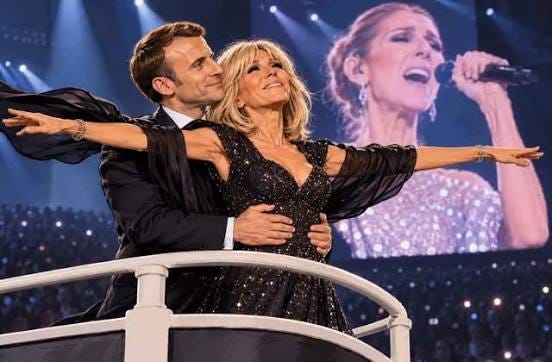
Photo montage by Frédéric Vignale
It is hard to escape the impression of a president who simply doesn’t care.
When riots kicked off after the police killing of Nahel Merzouk in June 2023, Macron danced to Elton John. During the nationwide strikes against pension reform, he was among those giving a standing ovation at a Paris theatre. Activists alerted to his presence stormed the stage, forcing security personnel to whisk the insouciant theatrophile to safety.
These were no isolated faux pas. As France battled wildfires and tenants suffered in poorly ventilated flats last August, he posed on a jet ski for the cover of a major magazine.
Such are the privileges of France’s presidential system: Macron is free to dance (badly) to pop, while leaving his prime minister to handle the grubby business of governing – or to concoct conspiracy theories that absolve the government of responsibility.
Five weeks into an escalating national crisis, we have an Education Minister who has yet to offer a substantive response to students’ demands; a police force that has beaten children and fired stun grenades and tear gas at point-blank range; and an Interior Minister who has apologised not for police violence – despite more than 30 internal investigations – but for not going far enough.
And how has the government responded? With instructions to prosecutors to demand stiffer sentences. Recurring curfews. More police. And plans to deploy the army.
This is the very apparatus authoritarian regimes dream of – deployed six months before a presidential election in which the far right is well ahead in the polls.

